Breathwork at Work: Using Your Breath for Stress, Focus and Clarity
Breathwork at Work: Using Your Breath for Stress, Focus and Clarity
Breathwork at work can offer a simple way to pause during a busy day. Research suggests controlled breathing practices may help reduce stress and influence mood and physiological arousal, although the evidence for improving concentration or work performance is much less certain.
Most working days contain transitions.
From home to work.
Email to meeting.
Meeting to meeting.
Conversation to presentation.
Problem to problem.
One task finishes and, almost immediately, another begins.
What they don't always contain is much space between those transitions.
We close one tab and open another.
Leave one video call and join the next.
Finish a difficult conversation and immediately reply to an email.
Even lunch can become something we eat while looking at a screen.
Breathwork can't remove workload, change organisational culture or solve the structural causes of workplace stress.
But it can create something smaller.
A pause.
A few minutes in which we're not responding to the next demand.
And there is growing scientific interest in whether deliberate breathing practices could help support stress and wellbeing during everyday life.
So can breathwork actually help at work?
Could it improve focus?
And what does a useful workplace breathing practice look like when you don't particularly want to lie on a yoga mat in the middle of the office?
Let's explore.
What is workplace breathwork?
Workplace breathwork simply means using intentional breathing practices within a working environment.
That might be:
a two-minute breathing practice before a meeting,
five minutes between tasks,
a guided session as part of a workplace wellbeing programme,
a breathing practice before a presentation,
or a longer facilitated session for a team.
It doesn't need incense.
It doesn't require yoga clothes.
And it doesn't need everyone sitting cross-legged with their eyes closed.
At its simplest, breathwork involves deliberately paying attention to or changing the way we breathe.
And because breathing is already happening, it can be particularly practical in a workplace setting.
Why might breathing be useful during the working day?
Work requires us to move through different physiological and psychological states.
We might need:
focus to write a report,
energy to deliver a presentation,
patience during a difficult conversation,
creativity to solve a problem,
confidence to make a decision,
and then somehow the ability to switch off when the working day ends.
Our bodies respond to all of this.
A challenging email can change how we feel.
So can an approaching deadline.
Or back-to-back meetings.
Or speaking in front of 100 people.
Or being interrupted for the tenth time while trying to concentrate.
Breathing often changes alongside those states.
And because breathing can also be consciously changed, it offers an interesting point of intervention.
Can breathwork reduce stress at work?
The research specifically examining breathwork in workplaces is still developing.
But the broader evidence around breathwork and stress is encouraging.
A 2023 meta-analysis examined randomised controlled trials of breathwork interventions.
For its primary stress outcome, researchers analysed 12 studies involving 785 adults.
Breathwork was associated with a significant small-to-medium reduction in self-reported stress compared with non-breathwork controls.
The same review found similar improvements in anxiety and depressive symptoms. PubMed
However, the researchers were deliberately cautious.
Most studies were considered to have a moderate risk of bias, and breathwork interventions differed considerably.
So the evidence doesn't justify saying:
"Breathwork eliminates workplace stress."
It suggests something much more useful:
Intentional breathing may be one accessible tool for helping people manage their response to stress.
That's an important distinction.
Breathwork can't fix a stressful workplace
This deserves saying clearly.
If employees are:
chronically overworked,
understaffed,
being poorly managed,
experiencing bullying,
working unreasonable hours,
or dealing with unrealistic expectations,
a breathing exercise isn't the solution.
And workplace wellbeing becomes problematic when organisations use individual wellbeing interventions as a substitute for addressing working conditions.
Breathwork shouldn't communicate:
"You're stressed. Here's a breathing technique. Deal with it."
A more useful approach is:
"Work can be demanding. How can we create practices and environments that better support the people doing it?"
Breathwork can be part of that.
Not the whole answer.
What happens to our breathing when we're stressed?
You probably don't consciously decide to change your breathing when a stressful email arrives.
But breathing responds naturally to changes in our state.
It may become:
faster,
shallower,
less regular,
or interrupted by sighs and breath holding.
Heart rate, muscle tension, attention and other physiological processes can shift too.
That's part of the body's ability to respond to demand.
It isn't inherently bad.
But when the working day consists of one demand after another, we don't always get much opportunity to transition out of that activation.
A breathing practice creates a deliberate interruption.
How does slow breathing affect stress?
Slow breathing interacts with cardiovascular and autonomic processes.
One of the clearest findings in breathing research involves heart-rate variability, or HRV.
A systematic review and meta-analysis examining 223 studies found that voluntary slow breathing increased vagally mediated HRV during the breathing practice, immediately afterwards and following repeated interventions.
HRV is one measure researchers use when investigating autonomic regulation.
This doesn't mean that slow breathing simply flips the body from "stressed" to "relaxed".
But it provides physiological evidence that changing the breathing rhythm can influence systems associated with regulation.
That's one reason a few minutes of slower breathing can be an interesting workplace practice.
Can five minutes of breathing make a difference?
Possibly.
And this is where the research becomes particularly relevant to busy workplaces.
A 2023 randomised controlled study compared five minutes a day of several structured breathing exercises with five minutes of mindfulness meditation.
Participants practised daily for approximately one month.
All groups showed improvements in mood and reductions in anxiety.
But the breathwork groups produced greater improvements in positive affect than mindfulness meditation, with the strongest results seen in the cyclic sighing group, which emphasised longer exhalations.
The breathing groups also showed a greater reduction in respiratory rate. DOI
This doesn't mean five minutes of breathing will transform everyone's working day.
But it does challenge the assumption that a wellbeing practice has to take 30 or 60 minutes to be worth doing.
Five minutes is something we can actually work with.
What is cyclic sighing?
Cyclic sighing was the breathing technique that performed particularly well in that 2023 study.
It involves:
one inhale
followed by
a second smaller inhale
and then
a long, slow exhale.
The participants repeated this pattern for five minutes each day. DOI
You might recognise something similar from something the body already does naturally:
sighing.
Sighs aren't necessarily a sign that something is wrong.
They play a role in respiratory physiology.
And many of us naturally sigh after concentration, frustration or tension.
The structured practice takes that familiar respiratory pattern and repeats it deliberately.
However, at Breathe Into, we don't need everyone in an office doing one prescribed breathing technique.
Different practices can serve different purposes.
Can breathwork improve focus at work?
This is where we need to be particularly careful.
You'll frequently see claims such as:
"Breathwork improves concentration."
"Breathing increases productivity."
"Use this technique for laser focus."
The evidence isn't strong enough to make those claims universally.
Breathing may indirectly support concentration if it helps someone feel less overwhelmed, gives them a break from sustained cognitive demand or helps them transition between tasks.
But that isn't the same as proving that breathing itself improves cognitive performance.
And a fascinating 2025 study demonstrates why the distinction matters.
Could slow breathing actually make it harder to concentrate?
Potentially, if you're trying to deliberately control your breathing while doing another attention-heavy task at the same time.
Researchers studied 80 healthy young adults completing computer tasks in a simulated office.
Participants performed tasks both normally and while following personalised light-guided slow breathing.
During slow breathing, HRV increased.
Participants also reported less stress following a decision-making task.
So far, so good.
But during an attention task, deliberate slow breathing resulted in:
slower reaction times and more attentional lapses.
Participants also reported greater distraction. ScienceDirect
That's a wonderfully useful finding.
Because it tells us something practical.
Don't turn breathwork into another thing you're trying to multitask.
Take the pause first. Then do the work.
This is how I'd apply that research in real life.
Not:
control your breathing while writing the report.
Instead:
stop.
breathe.
then write the report.
Breathwork can be the transition between activities rather than something layered on top of them.
Three minutes before the presentation.
Five minutes after a difficult call.
A few breaths before opening the laptop.
A short pause before walking into a meeting.
Then let the breathing return to normal and give the next task your attention.
That feels much more aligned with the evidence.
And with Breathe Into.
What are microbreaks at work?
A microbreak is simply a short break taken during the working day.
Rather than waiting until you're completely exhausted and taking a week off, microbreaks create small moments of recovery between periods of work.
They might involve:
standing up,
stretching,
walking,
getting water,
looking away from the screen,
going outside,
or breathing.
The point isn't that breathwork is uniquely superior to every other form of break.
Sometimes walking around the block is exactly what you need.
But breathing has one enormous practical advantage:
it's available almost anywhere.
When could you use breathwork during the working day?
There are several moments where I think breathwork can be particularly useful.
Before starting work
Rather than opening your laptop and immediately entering your inbox, take two minutes.
Arrive first.
Before a meeting
Especially if you've just come from something demanding.
Allow one thing to finish before another begins.
Before presenting
Not necessarily to remove every nerve.
Some activation is useful.
But breathing can give you somewhere to place your attention.
After a difficult conversation
Rather than immediately carrying that conversation into the next task.
Pause.
Notice.
Breathe.
Between deep-work sessions
Get away from the screen.
Move.
Breathe.
Then return.
At the end of the working day
This might be the most valuable transition of all.
Work has finished.
But has your mind?
A short breathing practice can help mark the boundary between:
work
and
whatever comes next.
A two-minute breathing practice before a meeting
You don't need to close your eyes.
Nobody needs to know you're doing it.
Sit with both feet supported if that's comfortable.
Then:
1. Arrive
Notice your body in the chair.
Feel your feet.
Notice the breath without changing it.
2. Soften
Allow the breathing to become a little slower.
Not huge breaths.
Just:
slow, soft, comfortable breathing.
3. Lengthen
Try:
inhale for 4
exhale for 6.
Repeat for several rounds.
4. Stop
Return to normal breathing.
Ask yourself:
What do I want to bring into this conversation?
Clarity?
Curiosity?
Confidence?
Patience?
Openness?
Then join the meeting.
A five-minute reset between tasks
I use the word "reset" here in the everyday sense rather than suggesting we're literally resetting the nervous system.
Set a timer for five minutes.
Put your phone down.
Move away from your screen if you can.
For the first minute:
don't change anything.
Simply notice.
How are you?
Not:
How should I be?
How are you actually?
Then allow your breathing to slow.
You might use:
4 in
6 out.
Continue comfortably for around three minutes.
For the final minute, stop controlling your breathing.
Notice your body.
Notice the room.
And decide what you're moving into next.
That's it.
Five minutes.
No app required.
No equipment.
A breathing practice after a difficult conversation
This one is slightly different.
If you've just come out of a tense conversation, don't immediately tell yourself:
I need to calm down.
You may have a perfectly reasonable emotional response to what just happened.
Instead:
Put both feet on the floor.
Notice where you feel the experience in your body.
Don't interpret it yet.
Then try three slow breaths.
Allow the exhale to be unhurried.
You might ask:
What am I noticing?
Then:
What do I need before I move on?
Maybe it's another minute of breathing.
Maybe it's a walk.
Maybe you need to write something down.
Maybe you need to talk to someone.
Breathwork doesn't need to erase the response.
It can create enough space to listen to it.
A practice for switching off after work
This can be particularly useful for people who work from home.
The commute once created a natural transition.
You left the workplace.
Travelled.
Arrived home.
Remote working can reduce that transition to:
close laptop → kitchen.
Try creating one deliberately.
When work finishes:
close the laptop.
Put your phone aside.
Sit somewhere other than your working position if possible.
Take three releasing sighs.
Then breathe slowly for two or three minutes.
Perhaps:
in for 4
out for 6.
Then ask:
What am I leaving here today?
and:
What am I moving into now?
Then physically move.
Stand.
Stretch.
Walk outside.
Change rooms.
Make the end of work feel like an actual transition.
What about box breathing at work?
Box breathing is one of the most widely known workplace breathing practices.
It typically involves:
inhale for 4
hold for 4
exhale for 4
hold for 4.
Some people like it because the structure gives the mind something very specific to focus on.
That can be useful before a meeting or presentation.
But it isn't automatically better than simpler slow breathing.
And some people find breath holds uncomfortable.
If that's you, leave them out.
You don't receive extra wellbeing points for making the breathing technique harder.
What about breathing before a presentation?
This is an interesting one because the aim shouldn't necessarily be to become completely relaxed.
A presentation requires:
energy,
alertness,
presence,
and engagement.
If you're slightly nervous, that doesn't mean something has gone wrong.
Your body understands that something important is about to happen.
Rather than:
"How do I get rid of these nerves?"
try:
"How do I work with this energy?"
Feel your feet.
Allow the exhale to lengthen.
Look around the room.
Remember what you're there to communicate.
Breathe.
Then go.
Can breathwork improve productivity?
I'd be cautious with this claim.
Workplace wellbeing is frequently justified through productivity:
Do this because you'll get more done.
But wellbeing shouldn't only matter because it makes people more productive.
And research does not currently justify a broad claim that breathwork reliably increases workplace productivity.
In fact, as we've seen, consciously controlling slow breathing while performing an attention task may compete for cognitive resources and impair performance. ScienceDirect
The more defensible argument is that people benefit from having opportunities to:
pause,
recover,
transition,
manage stress,
and reconnect with attention.
Whether that subsequently changes productivity will depend on many factors.
Can breathwork help creativity?
Possibly indirectly, but again we don't need to overclaim.
Creativity doesn't always thrive when we're rushing from task to task.
Sometimes what helps is simply interrupting the stream of incoming information.
Not looking at the screen.
Not solving.
Not responding.
Just creating a little space.
Breathwork can provide that space.
And what happens inside it may be interesting.
But we don't need to promise that five breaths will make everyone more creative.
Breathwork for hybrid and remote workers
Remote work creates its own particular challenges.
Home can become:
office,
meeting room,
lunch room,
and living space
all at once.
That makes transitions particularly important.
Try associating a breathing practice with a repeated point in your day.
For example:
Before opening the laptop: three slow breaths.
After your final morning meeting: stand, stretch and breathe.
Before lunch: leave the desk and take five minutes.
At the end of work: close the laptop and complete your two-minute transition.
The breathing itself doesn't need to be complicated.
Consistency can matter more than novelty.
What about teams doing breathwork together?
This is where breathwork becomes particularly interesting for organisations.
A shared practice can create something that's often missing from working life:
a collective pause.
Rather than everyone arriving at a workshop or meeting from completely different demands and immediately launching into the agenda, you create a transition.
A few minutes to arrive.
To breathe.
To notice.
Then begin.
That doesn't mean everyone will feel the same afterwards.
They shouldn't have to.
The aim isn't enforced calm.
It's creating space before moving into what's next.
Do employees need to close their eyes?
No.
And I think this is particularly important in workplace breathwork.
Closing your eyes can feel comfortable for some people.
For others, especially in a group of colleagues, it may feel vulnerable or simply awkward.
So the invitation should always include choice.
Close your eyes if that feels comfortable, or soften your gaze somewhere in front of you.
People should also be able to:
sit,
stand,
adjust their position,
or stop participating.
A workplace wellbeing practice shouldn't require people to override their own comfort in order to appear cooperative.
Is workplace breathwork suitable for everyone?
Gentle breath awareness and comfortable slow breathing are accessible to many people.
But no practice is universally right for everybody.
Some people have respiratory or cardiovascular conditions.
Some are pregnant.
Some experience panic or anxiety when attention is placed on breathing.
Some simply don't enjoy breathwork.
More intensive practices can produce stronger physiological effects and require greater care.
That's why workplace breathwork should include:
clear explanations,
choice,
appropriate safety guidance,
and permission not to participate.
Nobody should be made to disclose a medical condition in front of colleagues to opt out of a wellbeing activity.
Should workplaces use intensive breathwork?
Context matters.
A two-minute slow-breathing practice before a meeting is very different from a longer Conscious Connected Breathing session.
Conscious Connected Breathing involves continuous breathing without deliberate pauses and can create stronger physical and emotional experiences.
That may be appropriate in a specifically designed and properly facilitated wellbeing session.
But it isn't something I'd casually introduce halfway through a management meeting.
The practice needs to suit:
the people,
the environment,
the purpose,
and the amount of time available.
At Breathe Into, this is why we think in terms of experiences rather than one universal breathwork session.
Breathwork isn't about making everyone calm
Workplaces don't need teams of permanently calm people.
Sometimes we need:
energy.
Urgency.
Excitement.
Challenge.
Debate.
Creativity.
Momentum.
The purpose of breathwork isn't to flatten those states.
It's to give people another way of noticing and working with their state.
Sometimes we want calm.
Sometimes clarity.
Sometimes connection.
Sometimes possibility.
Those are different experiences.
And breathwork can be used differently within each one.
Breathe Into Calm
Sometimes what a team needs is permission to slow down.
A Breathe Into Calm experience might explore gentle breathing, grounding and reflection.
Not because everyone is expected to leave completely relaxed.
But because creating deliberate moments of pause can be valuable in a culture that rarely stops.
Breathe Into Clarity
Clarity isn't necessarily created by thinking harder.
Sometimes we need to interrupt the thinking.
Pause.
Breathe.
Notice what is actually competing for attention.
Then return.
A Breathe Into Clarity experience can use breath, reflection and visualisation to create room around a question rather than forcing an immediate answer.
Breathe Into Connection
Breathwork doesn't have to be an individual activity.
Shared practice can change the pace of a room.
A Breathe Into Connection experience creates time to arrive together before exploring reflection, conversation and connection.
Particularly useful for teams who spend much of their time communicating transactionally.
Breathe Into Possibility
This is less about relaxation and more about creating space.
Space to think beyond:
deadlines,
to-do lists,
immediate problems,
and what already exists.
Breathing can become the starting point for reflection and visualisation.
Not:
"Here's what you should achieve."
But:
"What becomes possible when we create enough space to explore?"
The BREATHE INTO™️ Method at work
Whatever the setting, our approach follows the same four-stage journey:
Breathe
We begin with the breath.
Not because anyone is breathing incorrectly.
Because it gives us somewhere to arrive.
Listen
What's here?
Energy?
Tension?
Excitement?
Fatigue?
Noise?
Thoughts?
No need to immediately change any of it.
Explore
Now we become curious.
Perhaps we use breathwork.
Movement.
Humming.
Reflection.
Visualisation.
Journalling.
Different tools create different ways of exploring.
Intend
Finally:
What do you want to bring into what comes next?
Calm?
Clarity?
Connection?
Possibility?
Confidence?
Curiosity?
Something else entirely?
The answer belongs to the person experiencing it.
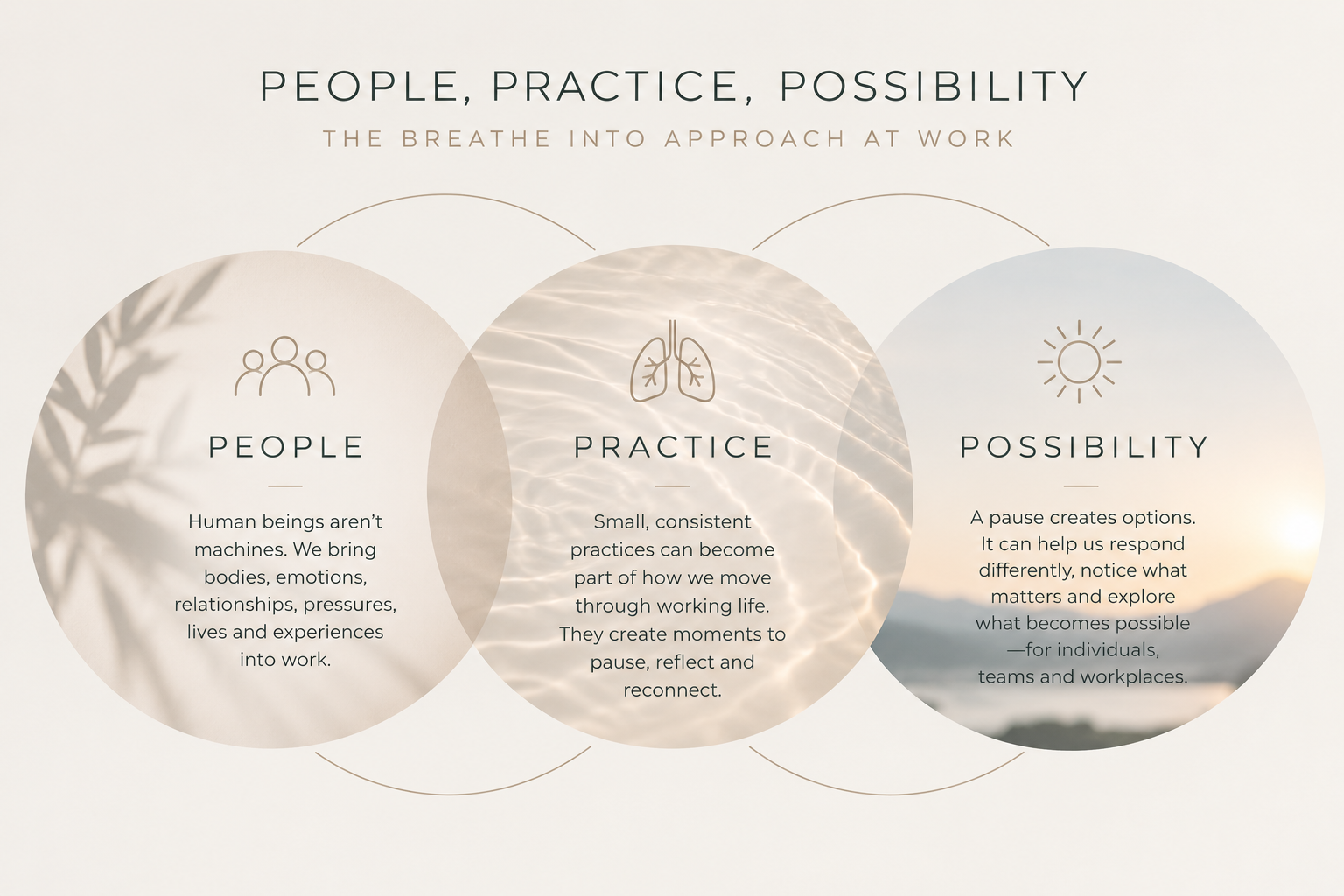
People, Practice, Possibility
There are three ideas underneath the way we think about workplace wellbeing.
People.
Human beings aren't machines.
We bring bodies, emotions, relationships, pressures, lives and experiences into work.
Practice.
Wellbeing isn't something we attend once a year.
Small practices can become part of how we move through working life.
Possibility.
A pause creates options.
Maybe nothing dramatic changes.
But perhaps we respond differently.
Notice something sooner.
Have a better conversation.
Or simply move into the next part of the day with a little more awareness.
That's enough.
A workplace doesn't need another thing to do
That's perhaps the irony of workplace wellbeing.
People are overwhelmed.
So we give them:
an app,
a challenge,
a webinar,
a programme,
a tracker,
a morning routine,
and seven new habits.
Now wellbeing is another task.
Breathe Into is interested in something different.
Not adding more.
Creating a little less.
Less noise.
Less rushing from one thing to another.
Less pressure to optimise every moment.
And a little more:
space,
awareness,
curiosity,
connection.
Sometimes that starts with an hour-long experience.
Sometimes five minutes.
Sometimes three breaths before opening the door to the next meeting.
Small doesn't necessarily mean insignificant.
Frequently Asked Questions About Breathwork at Work
What is workplace breathwork?
Workplace breathwork involves using intentional breathing practices during the working day or as part of employee wellbeing programmes. Practices can range from a few minutes of gentle slow breathing to longer facilitated group experiences.
Does breathwork reduce workplace stress?
Research specifically conducted in workplaces is still limited, but broader breathwork research is encouraging. A meta-analysis of 12 randomised controlled trials involving 785 adults found breathwork was associated with a small-to-medium reduction in self-reported stress compared with controls. PubMed
Can breathing exercises improve focus at work?
Evidence is mixed and depends on how breathing is used. A 2025 simulated-office study found slow breathing increased HRV and reduced perceived stress during one decision task, but impaired performance during an attention task when participants controlled their breathing while working. This suggests breathing may be better used as a break between demanding tasks rather than something to consciously maintain while concentrating. ScienceDirect
What is a good breathing exercise for work stress?
A simple option is to inhale comfortably for four counts and exhale for six for a few minutes. The breathing should feel slow and comfortable rather than unusually deep. If counting is distracting, simply slow the breathing gently.
Can five minutes of breathwork help?
A 2023 randomised controlled trial found that five minutes of daily structured breathing over approximately one month improved mood and reduced anxiety, with exhale-focused cyclic sighing producing particularly strong improvements in positive affect and respiratory rate. DOI
Is box breathing good for work?
Some people find box breathing useful because its equal inhale, hold, exhale and hold structure provides a clear attentional focus. It isn't necessary to use breath holds, however, and simpler slow breathing may feel more comfortable for some people.
Can breathwork help before public speaking?
Slow breathing may help some people manage feelings of activation before presenting. The aim doesn't need to be eliminating nerves entirely. Some activation is useful for performance; breathwork can simply provide a focus and a short pause before beginning.
Can employers offer breathwork as a wellbeing activity?
Yes. Breathwork can form part of a broader workplace wellbeing programme, provided sessions are appropriately facilitated and employees have choice about participation. Breathwork shouldn't be presented as a substitute for addressing organisational causes of workplace stress.
Do people need to close their eyes during workplace breathwork?
No. Participants should be able to keep their eyes open, soften their gaze, change position or opt out. Choice is particularly important when breathwork is offered in professional group settings.
Is workplace breathwork suitable for remote teams?
It can be. Short guided breathing practices can be delivered online and may provide a useful transition at the beginning or end of virtual workshops and team sessions. Individual breathing practices can also help remote workers create boundaries between work and home.
BRING BREATHE INTO TO YOUR WORKPLACE
Thoughtful, breath-led wellbeing experiences that create space for people to pause, reconnect and explore what they need.
From Breathe Into Calm and Breathe Into Clarity to Breathe Into Connection and Breathe Into Possibility, sessions can be created for team wellbeing days, away days, events and ongoing workplace programmes.
EXPLORE BREATHE INTO FOR WORKPLACES →
References and further reading
Fincham GW, Strauss C, Montero-Marin J, et al. Effect of breathwork on stress and mental health: A meta-analysis of randomised-controlled trials. Scientific Reports. 2023;13:432. The primary analysis included 12 RCTs and 785 participants and found a significant small-to-medium effect on self-reported stress. PubMed
Balban MY, Neri E, Kogon MM, et al. Brief structured respiration practices enhance mood and reduce physiological arousal. Cell Reports Medicine. 2023;4(1):100895. The randomised study compared five-minute daily breathwork practices with mindfulness meditation over one month. DOI
Breathing environment: Exploring the feasibility and efficacy of personalized, light-guided slow breathing while performing two computer tasks in a simulated office environment. Computers in Human Behavior Reports. 2025;18:100661. The study involved 80 healthy young adults and found increased HRV and some reductions in perceived stress, alongside impaired attentional performance when slow breathing was performed concurrently with an attention task. ScienceDirect
University of Surrey. Researchers have also been specifically investigating whether short breathing exercises after work can help employees manage work-related stress and switch off during leisure time, illustrating the growing research interest in breathwork within occupational wellbeing. University of Surrey
Please note: This article provides general wellbeing information and isn't medical advice. Breathwork should not replace appropriate medical, psychological or occupational-health support.
BREATHE A LITTLE MORE INTO YOUR INBOX
Thoughtful notes for everyday wellbeing
Join the BREATHE INTO list for new articles, simple practices, reflections and occasional news about classes, events and BREATHE INTO experiences.
By signing up to this blog you consent to receive regular emails from BREATHE INTO with updates and the occasional promotion for products. You can unsubscribe at any time. View our privacy policy in the footer.
MEET DEE