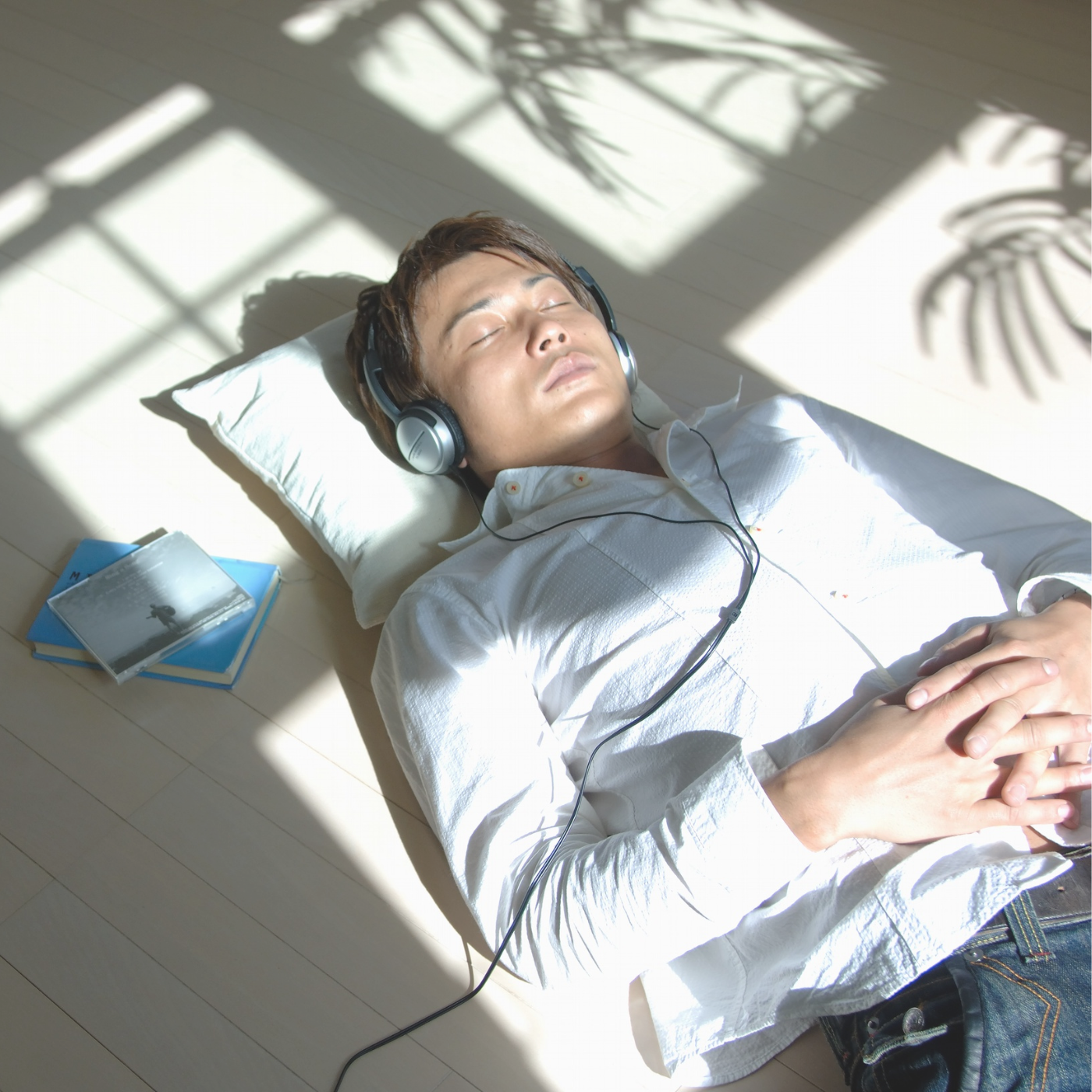
Breathwork for Sleep: Breathing Techniques to Help You Wind Down at Night
Breathwork for Sleep: Breathing Techniques to Help You Wind Down at Night
You're tired.
You've been looking forward to bed for hours.
You finally switch off the light, put your head on the pillow...
…and your brain decides this is the perfect moment to think about everything.
Tomorrow's meeting.
The thing you forgot to do.
A conversation from three days ago.
Whether you replied to that email.
Something you need to remember in the morning.
And suddenly, although your body is tired, sleep feels surprisingly far away.
It's one of the reasons breathing exercises have become so popular at bedtime.
Unlike scrolling, reading another article or checking the time again, the breath doesn't require us to do very much.
It's already there.
And there is growing scientific interest in whether deliberately slowing our breathing before bed might help prepare the body and mind for sleep.
A 2026 systematic review found that slow breathing before bedtime was associated with improvements in self-reported sleep quality and sleep duration, although results from objective sleep measurements were inconclusive. PubMed
So breathwork isn't a sleeping pill.
And we can't promise that a particular breathing pattern will make you fall asleep in 60 seconds.
But breathing may offer something useful.
A way to transition from the activity of the day towards rest.
Let's look at why.
Can breathwork help you sleep?
The short answer is:
Possibly, yes.
But the evidence needs some context.
In 2026, researchers published a systematic review specifically examining slow breathing techniques performed before bedtime.
Nine studies involving a total of 457 participants met the inclusion criteria.
Seven studies measured sleep through participants' own reports. Across those studies, slow breathing was associated with improvements in perceived sleep duration and sleep quality.
However, the studies that measured sleep objectively using actigraphy or polysomnography produced inconclusive results. PubMed
That's an important distinction.
People may feel that they're sleeping better after regularly practising slow breathing.
But we don't yet have equally convincing evidence showing consistent changes in objectively measured sleep architecture.
That doesn't make the subjective improvements meaningless.
How rested you feel and how you experience your sleep matter enormously.
It simply means the science isn't yet strong enough to say:
"Breathwork has been proven to improve sleep."
A more accurate conclusion is:
Slow breathing before bed is a promising, low-cost practice that may help some people improve their experience of sleep, but more high-quality research is needed.
Why can it be so difficult to switch off at night?
Sleep isn't simply the absence of wakefulness.
It's a complex biological process influenced by many things, including:
- our circadian rhythm
- sleep pressure
- light exposure
- activity
- stress
- caffeine and alcohol
- physical health
- mental health
- medication
- environment
- habits and routines.
The NHS lists stress, anxiety and depression among common causes of insomnia, alongside factors including noise, uncomfortable temperatures, caffeine, alcohol, nicotine, jet lag and shift work. Medical conditions and some medications can also interfere with sleep. nhs.uk
So if you struggle to sleep, it doesn't necessarily mean that you need to "calm your nervous system".
And it certainly doesn't mean you've somehow forgotten how to sleep.
But for some people, pre-sleep arousal is part of the picture.
The body is in bed.
The mind is still at work.
What is pre-sleep arousal?
Pre-sleep arousal is essentially a state of increased mental or physical activation around bedtime.
It can look like:
Mental arousal
Racing thoughts.
Planning.
Problem-solving.
Replaying conversations.
Worrying.
Thinking about whether you're going to sleep.
Or:
Physical arousal
Feeling restless.
Noticing your heart beating.
Muscle tension.
Difficulty getting comfortable.
Breathing that feels quick or unsettled.
Feeling tired but somehow still "on".
And then there's another layer.
You notice you're not sleeping.
You check the clock.
It's 11:47.
Then 12:18.
Then 1:03.
And now you're calculating:
"If I fall asleep right now, I can still get six hours and 27 minutes..."
Sleep has become a task.
And tasks require effort.
Unfortunately, trying really hard to sleep isn't particularly conducive to sleep.
Where does breathing come into this?
Breathing changes with our state.
When we're physically active, it changes.
When we're frightened, it changes.
When we're concentrating, laughing, crying or talking, it changes.
And when we're sleeping, respiratory patterns change too.
But breathing has an unusual characteristic.
It happens automatically...
and we can also deliberately influence it.
We can consciously breathe:
slower,
faster,
more softly,
more deeply,
through the nose,
through the mouth,
or according to a particular rhythm.
That gives us a potential way of influencing some of the physiological processes associated with arousal.
How might slow breathing help with sleep?
There probably isn't one single explanation.
Slow breathing interacts with several systems involved in our physiological state.
One area of particular interest is the autonomic nervous system, which helps regulate functions including heart rate, blood pressure, digestion and aspects of breathing.
Slow breathing has repeatedly been shown to alter heart-rate variability, or HRV.
The 2026 systematic review of slow breathing and sleep found that six of its nine included studies also examined HRV, with evidence that slow breathing influenced autonomic activity. PubMed
A much larger systematic review and meta-analysis involving 223 slow-breathing studies has previously found increases in vagally mediated HRV during slow breathing, immediately afterwards and following repeated breathing interventions.
So slow breathing appears capable of influencing physiological processes associated with autonomic regulation.
But this doesn't mean:
slow breathing switches off your stress response and switches on sleep.
Sleep physiology is far more complicated.
Think of breathing less as an ON button for sleep...
and more as part of the process of winding down.
Does slow breathing before bed actually work?
One interesting randomised study gives us a useful example.
Researchers divided 64 healthy young adults into two groups.
One group practised 15 minutes of slow-paced breathing every evening for 30 days.
The other spent the same amount of time using social media.
After 30 days, the slow-breathing group reported improved sleep quality compared with the social-media group. Researchers also observed increased overnight cardiac vagal activity. PubMed
There are obvious limitations.
It was a relatively small study.
The participants were young and healthy.
And comparing slow breathing with social-media use doesn't tell us whether breathing would outperform other relaxing bedtime activities.
But it does suggest something interesting:
what we do during the transition into sleep may matter.
What about people who already have insomnia?
There is some evidence here too, although it remains limited.
One small study involving 14 people who reported insomnia and 14 good sleepers examined slow paced breathing.
Participants with insomnia who practised 20 minutes of slow breathing before bed showed improvements in sleep measures including sleep-onset latency, number of awakenings, time awake during the night and sleep efficiency. PubMed
Another study involving people with insomnia examined mindful breathing combined with sleep-inducing exercises alongside usual treatment.
Improvements were seen in sleep quality, sleep duration, sleep latency and insomnia severity after one and three months compared with usual treatment alone. However, because breathing was combined with another intervention, we can't attribute those results to breathing alone. PubMed
Again:
Promising.
Interesting.
Worth exploring.
But not evidence that breathwork should replace established insomnia treatment.
What is the best breathing technique for sleep?
There isn't currently one breathing technique that research has established as the best for sleep.
And that is worth saying clearly because the internet is full of very confident claims about specific breathing ratios.
You may see:
4-7-8 breathing
box breathing
coherent breathing
resonance breathing
4-6 breathing
diaphragmatic breathing
all described as the breathing technique for sleep.
The research doesn't justify choosing one universal winner.
The 2026 systematic review defined slow breathing broadly as 10 breaths per minute or fewer, and the protocols varied between studies. PubMed
For Breathe Into, we'd start somewhere much simpler:
Slow. Soft. Comfortable.
You don't need to breathe perfectly to fall asleep.
A simple breathing exercise for sleep
Try this once you're in bed or during the last few minutes before you get into bed.
There is nothing to achieve.
You're simply giving your attention somewhere to settle.
1. Get comfortable
Lie in whatever position feels natural.
You don't need to lie perfectly flat on your back.
If you're a side sleeper, stay on your side.
Let the bed support you.
2. Notice before changing
Where can you feel your breath?
Around your nose?
Chest?
Ribs?
Abdomen?
You don't need to change it yet.
Just listen.
3. Allow the breathing to soften
Rather than taking a huge "deep breath", see if the breathing can become:
a little slower
and
a little softer.
No gulping air.
No forcing.
4. Try 4 in, 6 out
If counting feels comfortable:
Inhale gently for 4.
Exhale softly for 6.
Repeat.
If that's too long:
3 in, 4 out is perfectly fine.
If counting feels irritating, stop counting.
Simply allow your exhale to feel easy and unhurried.
5. Let the numbers disappear
After a few minutes, you don't need to keep controlling the breath.
Let it find its own rhythm again.
Notice the weight of your body against the bed.
The temperature of the room.
The sounds around you.
And allow sleep to arrive in its own time.
Why we don't say "take a deep breath"
This comes up throughout Breathe Into because it's an important distinction.
When people want to relax, they're often told:
Take a big deep breath.
So they inhale as much air as possible.
Then another.
Then another.
But a calming breath doesn't need to be enormous.
Repeatedly breathing much more deeply or quickly than your body requires can lead to overbreathing and changes in carbon dioxide levels, potentially producing sensations such as light-headedness or tingling.
That's not especially helpful when you're trying to fall asleep.
So instead of:
BIG, DEEP BREATH
think:
slow, soft, comfortable breath.
You're winding down.
Not performing a breathing exercise.
What about 4-7-8 breathing for sleep?
This is probably the most famous breathing technique associated with sleep.
The pattern is:
Inhale for 4
Hold for 7
Exhale for 8
The NHS includes 4-7-8 breathing among its meditation and sleep suggestions, noting that the repetitive counting can focus attention on the breath and may help ease troubling thoughts. nhs.uk
But there's an important distinction between:
a technique being reasonable to try
and
a technique being clinically proven to make people fall asleep.
There isn't strong evidence demonstrating that the precise 4-7-8 ratio is uniquely effective for sleep.
If you enjoy it and it feels comfortable, there's nothing wrong with using it.
But if holding your breath for seven counts feels difficult or makes you more alert, you don't need to do it.
Breathing isn't more effective because it's harder.
What about box breathing for sleep?
Box breathing usually follows an equal pattern such as:
inhale 4
hold 4
exhale 4
hold 4.
It's often used for focus and stress management.
Some people find its predictable structure settling.
Others find breath holds require too much concentration at bedtime.
Again, there's no requirement to use it.
If your goal is sleep, I would generally begin with uncomplicated slow breathing rather than introducing multiple breath holds.
Is a longer exhale better for sleep?
Perhaps, but we shouldn't overstate the evidence.
Heart rate naturally changes across the breathing cycle, tending to increase during inhalation and decrease during exhalation.
Longer exhalations can feel particularly settling for some people.
That's why we often use 4 in, 6 out as a simple Breathe Into practice.
But research has not established that a particular inhale-to-exhale ratio is necessary for relaxation or sleep.
The useful question isn't:
"Have I got the perfect ratio?"
It's:
"Does this feel comfortable enough that I can stop thinking about it?"
Because ultimately, that's where we're trying to go.
Away from effort.
Can breathing help stop racing thoughts at night?
Potentially.
But not because the breath magically switches thoughts off.
Trying to stop thinking can become another impossible bedtime task.
Breathing gives attention somewhere else to rest.
Instead of:
Tomorrow...
That email...
What time is it?...
Why am I not asleep?...
your attention has something simple and repetitive:
inhale
exhale
inhale
exhale.
The NHS describes sleep meditation similarly: focusing gently on something such as breathing, a sound, sensation or repeated phrase can help focus the mind and support relaxation. nhs.uk
The goal isn't an empty mind.
It's a softer relationship with what's passing through it.
What if focusing on my breathing keeps me awake?
Then don't.
This is important.
For some people, counting breaths becomes another cognitive task.
Was that four?
Am I breathing slowly enough?
Was my exhale six?
Should I start again?
That's the opposite of what we want.
If counting makes you more alert, let the numbers go.
You might simply notice:
the feeling of the exhale
or
the weight of your body on the mattress.
You could listen to a gentle guided practice.
Or breathwork might not be the best sleep tool for you.
That's okay.
Can breathing help if you wake during the night?
A gentle breathing practice can be used if you wake during the night and find yourself becoming mentally busy.
But again, be careful not to turn it into a test.
Not:
"I need to do this so I can get back to sleep."
More:
"I'm awake. I'm going to give myself somewhere gentle to rest my attention."
Notice your body.
Notice the bed beneath you.
Allow the breathing to soften.
Perhaps use a longer comfortable exhale.
And try not to repeatedly check the time.
What if breathwork doesn't help me sleep?
Then that is useful information too.
Sleep difficulties have many causes.
Breathwork can't address all of them.
The NHS recommends several habits that may support sleep, including keeping regular sleeping and waking times, allowing time to relax before bed, keeping the bedroom dark and quiet, exercising during the day and limiting caffeine, alcohol and screens close to bedtime. nhs.uk
Sometimes the thing keeping you awake isn't a breathing problem.
It might be:
stress,
pain,
menopause,
medication,
shift work,
sleep apnoea,
anxiety,
depression,
your environment,
or an underlying sleep disorder.
A breathing exercise shouldn't distract from investigating the actual problem.
Is breathwork a treatment for insomnia?
Breathwork may be a useful complementary practice, but persistent insomnia deserves more than a collection of sleep hacks.
The NHS defines insomnia as regularly having difficulty falling asleep or staying asleep and notes that it can last for months or years. If changing sleep habits hasn't helped, it recommends speaking to a GP. nhs.uk
For persistent insomnia, cognitive behavioural therapy for insomnia (CBT-I) is an established treatment approach.
Breathing can sit alongside appropriate care.
It shouldn't replace it.
What about sleep apnoea?
This deserves its own mention because sleep apnoea is very different from struggling to wind down at bedtime.
Sleep apnoea involves breathing stopping and starting during sleep.
Possible signs include:
loud snoring,
gasping or choking noises,
frequent waking,
and feeling very tired during the day.
A bedtime breathing exercise does not treat obstructive sleep apnoea.
If you or someone sleeping beside you notices symptoms of interrupted breathing during sleep, speak to a healthcare professional.
Should you use Conscious Connected Breathing before sleep?
Generally, I wouldn't treat Conscious Connected Breathing as interchangeable with a gentle bedtime breathing practice.
Conscious Connected Breathing involves a continuous connected breath without deliberate pauses between inhale and exhale.
Depending on the pace and depth, it can create stronger physiological sensations and can be activating.
That's quite different from the slow, soft breathing we're discussing here.
Some people may feel relaxed after a longer breathwork session.
Others may feel energised or emotionally stimulated.
So if the aim is simply:
"I'd like to settle before bed"
I'd choose a gentler breathing practice.
Not all breathwork needs to do the same job.
A five-minute Breathe Into bedtime practice
If you want something slightly more complete than counting breaths, try this.
Minute 1: Arrive
Get comfortable.
Notice where your body meets the bed.
Feel its support beneath you.
Nothing needs to happen yet.
Minute 2: Listen
Notice the breathing.
Don't correct it.
Is it fast?
Slow?
Shallow?
Smooth?
Uneven?
Just listen.
Minutes 3–4: Breathe
Let the breath soften.
Perhaps:
in for 4
out for 6.
Or simply:
easy inhale
long, unhurried exhale.
Minute 5: Let go
Stop controlling the breath.
Allow it to breathe itself.
Notice three places where your body feels supported by the bed.
And then let go of the practice too.
You don't need to wait to feel "properly relaxed".
You're finished.
Why the final step matters
This is perhaps the part of bedtime breathwork that gets overlooked.
Eventually:
stop doing the breathwork.
If you keep monitoring:
Am I relaxed yet?
Has my heart rate dropped?
Is my nervous system regulated?
Am I sleepy now?
you're still performing a task.
Sleep requires us, eventually, to relinquish control.
So use the breath to help create the transition.
Then let the breath go too.
Creating a transition between day and night
This is perhaps where breathwork is most useful.
Modern life doesn't always give us much transition.
One minute:
emails.
Messages.
Netflix.
News.
Instagram.
Work.
Planning.
Problem-solving.
And then:
Right. Sleep now.
Our minds don't necessarily operate according to that timetable.
A bedtime practice creates a small boundary between the two.
It might be:
putting your phone away,
lowering the lights,
washing your face,
making tea,
reading,
journalling,
stretching,
breathing.
None of these things need to become an elaborate "perfect evening routine".
They're simply signals:
The active part of the day is ending.
Breathwork shouldn't become another sleep rule
This is especially important if you already struggle with sleep.
You don't need:
the perfect bedroom.
the perfect bedtime.
the perfect breathing technique.
the perfect morning light.
the perfect magnesium supplement.
the perfect sleep score.
Sometimes our attempts to optimise sleep make us more preoccupied with sleep.
So if you miss your breathing practice one evening?
Nothing has gone wrong.
If you breathe for two minutes instead of ten?
Fine.
If you fall asleep halfway through?
Even better.
The practice is there to support sleep.
Sleep isn't there to prove that the practice worked.
Breathe → Listen → Explore → Intend at bedtime
The Breathe Into approach works particularly beautifully at the end of the day.
Breathe
Begin where you are.
A few slow, soft breaths.
No need to force relaxation.
Listen
What is here tonight?
Tiredness?
Restlessness?
Thoughts?
Tension?
Contentment?
Energy?
You don't need to label any of it as wrong.
Explore
What feels supportive?
A longer exhale?
A hum?
A stretch?
A few words in a journal?
Quiet?
A guided practice?
Intend
What would you like to invite as the day closes?
Rest?
Softness?
Stillness?
Perhaps simply:
permission to stop.
Not an instruction to sleep.
An invitation to rest.
You don't have to make yourself sleep
Perhaps that's the most useful thing to remember.
Sleep isn't something we can command.
You can't force yourself unconscious.
But you can create conditions that make rest more possible.
You can lower the lights.
Put down the phone.
Allow the day to finish.
Soften the body.
Slow the breathing.
And stop asking yourself to achieve anything else.
Breathwork isn't about making yourself sleep.
It's an opportunity to mark the transition.
From doing...
to resting.
From responding...
to listening.
From the day that has been...
to whatever comes next.
One slow breath.
One softer exhale.
And then perhaps you don't need to do anything at all.
Frequently Asked Questions About Breathwork for Sleep
Can breathing exercises really help you sleep?
Research is encouraging but not conclusive. A 2026 systematic review of nine studies involving 457 participants found improvements in self-reported sleep quality and duration following slow breathing before bedtime. However, findings from objective sleep measurements were inconclusive. PubMed
What is the best breathing exercise for sleep?
There isn't one breathing exercise proven to be best. Slow breathing is the most relevant category studied specifically before bedtime. A simple practice is to inhale comfortably for four counts and exhale for six, adjusting the counts if necessary.
What is the 4-7-8 breathing method for sleep?
4-7-8 breathing involves inhaling for four seconds, holding for seven and exhaling for eight. The NHS includes it as one breathing technique that can be tried as part of sleep meditation, although evidence doesn't establish that this particular ratio is uniquely effective. nhs.uk
How long should I do breathing exercises before bed?
Research protocols vary. One randomised study found improved subjective sleep quality after participants practised 15 minutes of slow-paced breathing each evening for 30 days. That doesn't mean 15 minutes is necessary. Five minutes of comfortable slow breathing can be a practical starting point. PubMed
Is it better to breathe through your nose or mouth for sleep?
For quiet, gentle breathing at rest, nasal breathing is generally comfortable and appropriate for many people. But you don't need to force nasal breathing if congestion or another issue makes it uncomfortable.
Does a longer exhale help you sleep?
A longer exhale may feel settling and interacts with the natural relationship between respiration and heart rate, but research hasn't established a particular inhale-to-exhale ratio as essential for sleep. Comfort matters more than achieving exact numbers.
Can breathwork cure insomnia?
No. Some small studies have reported improvements in insomnia-related outcomes, but the evidence isn't sufficient to describe breathwork as a cure or replacement for established insomnia treatment. Persistent sleep problems should be discussed with an appropriate healthcare professional. PubMed
Can I use breathwork if I wake up at 3am?
You can try gentle slow breathing as a way of resting your attention if you wake during the night. Avoid making it another task you must complete in order to sleep. If waking frequently is persistent, investigate the underlying cause rather than relying solely on breathing exercises.
Does breathwork increase deep sleep?
We don't currently have strong enough evidence to claim this. A small polysomnography pilot study found a change in delta power during N3 sleep after pre-sleep slow breathing, but the sample was very small and broader objective findings remain inconclusive. PubMed Central (PMC)
Can breathwork replace sleeping tablets?
No. Don't stop or change prescribed medication on the basis of a breathing practice without discussing it with the healthcare professional responsible for your treatment.
References and further reading
Eide EM, Hernes HM, Grønli J. Slow breathing techniques before bedtime and the effects on sleep: A systematic review. Sleep Medicine Reviews. 2026;87:102284. This is particularly useful for us because it specifically reviews pre-bed slow breathing rather than breathwork more broadly. PubMed
Laborde S, Hosang TJ, Mosley E, Dosseville F. Influence of a 30-Day Slow-Paced Breathing Intervention Compared to Social Media Use on Subjective Sleep Quality and Cardiac Vagal Activity. Journal of Clinical Medicine. 2019;8(2):193. PubMed
Tsai HJ, Kuo TBJ, Lee GS, Yang CCH. Efficacy of paced breathing for insomnia: enhances vagal activity and improves sleep quality. Psychophysiology. 2015;52(3):388–396. PubMed
Eide EM, et al. The Effects of Presleep Slow Breathing and Music Listening on Polysomnographic Sleep Measures – a pilot trial. Scientific Reports. 2020. PubMed
NHS Every Mind Matters. Guidance on sleep, meditation and breathing includes relaxation, breathing and 4-7-8 breathing among practices people may explore alongside healthy sleep habits. nhs.uk
Please note: This article is for general wellbeing information and isn't medical advice. Persistent sleep problems, significant daytime sleepiness, suspected sleep apnoea or other concerning symptoms should be discussed with an appropriately qualified healthcare professional.
BREATHE A LITTLE MORE INTO YOUR INBOX
Thoughtful notes for everyday wellbeing
Join the BREATHE INTO list for new articles, simple practices, reflections and occasional news about classes, events and BREATHE INTO experiences.
By signing up to this blog you consent to receive regular emails from BREATHE INTO with updates and the occasional promotion for products. You can unsubscribe at any time. View our privacy policy in the footer.
MEET DEE